
Underwater housing maintenance: what to do, when to do it and why not to put it off

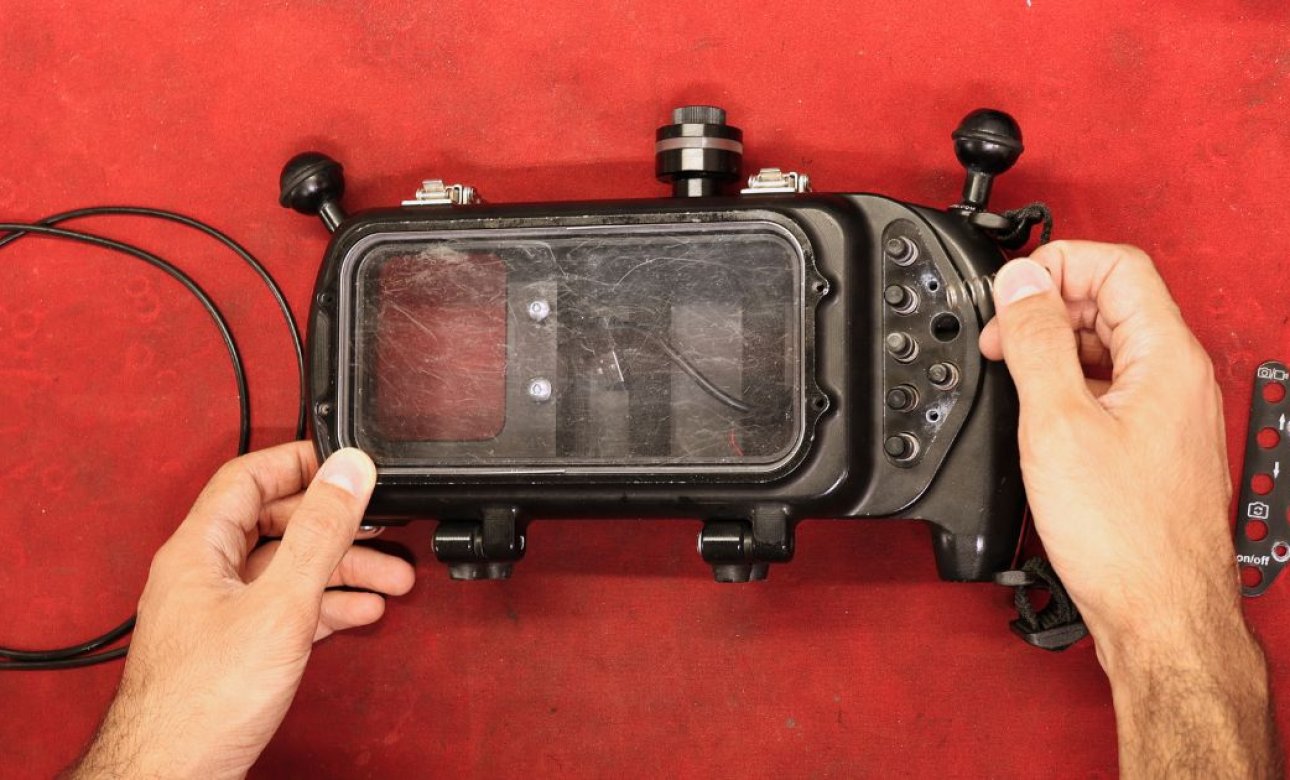
There's something we hear often: "I've used it for years, I've never had a problem, I'll skip maintenance this year."
It's a sentence we understand. It's also a sentence that, on average, costs dearly.
Not because the housing breaks right away. But because an O-ring that deteriorates slowly, below the surface, gives no warning until the wrong moment. And because the lifetime warranty, the one that makes an Easydive housing different from any other, only works if maintenance is carried out on time.
This post explains what really happens during maintenance, when to do it, and why what looks like a fixed cost is actually the only way to protect a significant investment.
What is underwater housing maintenance?
Maintenance isn't a repair. It's not done when something breaks, it's done to prevent something from breaking.
An underwater housing works in extreme conditions: variable pressure, salt water, temperature swings, UV light. Every dive puts physical stress on the components that builds up over time in invisible ways. O-rings compress and deteriorate. Internal wiring wears down. Buttons accumulate deposits. Software ages relative to the camera it houses. Periodic maintenance catches these issues before they turn into failures.
What happens during Easydive maintenance?
The standard maintenance cycle includes four steps.
1. O-ring replacement
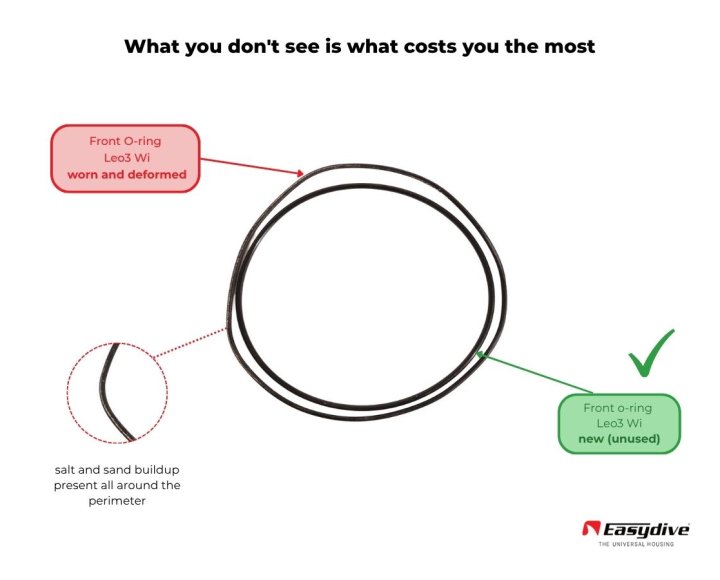
O-rings are the seals that guarantee the housing's watertightness. They're made of rubber, they work under pressure, and they deteriorate over time, even when no damage is visible to the naked eye. Preventive replacement is the simplest and most important step in the whole maintenance process. An O-ring that fails at -30 metres gives no warning signs. You find out when it's too late.
2. Check of magnetic buttons and wiring
Every button is tested individually. Internal wiring is inspected to check for wear, oxidation or loose connections. This is a check that requires specific tools, it's not something you can do by looking at the housing from the outside.
3. Software update
Cameras evolve continuously: new firmware, new menus, new functions. The housing's software needs to be updated to correctly recognise the commands of the camera it houses. A missed update doesn't break anything, but it can make some controls less responsive or cause functions you took for granted to disappear.
4. Re-testing in the pressure chamber
This is the step that sets real maintenance apart from a simple visual check. After every intervention, the housing is tested in a hyperbaric chamber at simulated pressures equivalent to its guaranteed depth.
If it passes the test, it leaves the lab as good as new. If it doesn't, it gets repaired and re-tested. No housing goes back to the customer without having passed all the required tests.
Why do maintenance if I've never had a problem?
It's the right question. And the answer is counterintuitive: precisely because you've never had a problem.
Easydive housings are designed not to break. Renata Romeo, an underwater photographer based in the Red Sea, uses hers every day in demanding conditions, warm water, salt, constant pressure, and says she's never had a problem. Zero. And yet she still brings it in for maintenance.
It's not a contradiction. It's exactly the point.
Maintenance doesn't fix something broken. It certifies that everything works before you dive to -80 metres with a 3,000-euro camera inside. It's the difference between knowing and hoping.
"I've already spent a lot on the housing. Why do I have to keep paying every year?"
It's the most honest objection there is. It deserves an equally honest answer.
When you buy an Easydive housing, you're buying a product built to last for decades: aluminium machined from a solid block, magnetic buttons with no mechanical parts subject to wear, a double radial-seal O-ring, electronics that can be updated over time. It's not a disposable housing. It's a system.
Annual maintenance is what keeps that system working like it did on day one. And the cost isn't arbitrary: it covers the physical replacement of the O-rings, the manual check of every button and cable, the firmware update, and multiple pressure-chamber tests that no visual inspection can replace.
Put in perspective: an Easydive housing used for 10 years with annual maintenance has a history of 30 pressure-chamber tests, 10 preventive O-ring replacements, 10 software updates. It's not the same housing you bought, it's a housing that's been checked and certified 10 times.
A competing dedicated housing costs less per year in maintenance because it's often not done at all. Yet it has more openings and more water entry points than a universal housing: it would need more frequent maintenance, not less. When the camera becomes obsolete, you throw it away and start over.
The real cost is less visible. But it's higher.
When should you do maintenance?
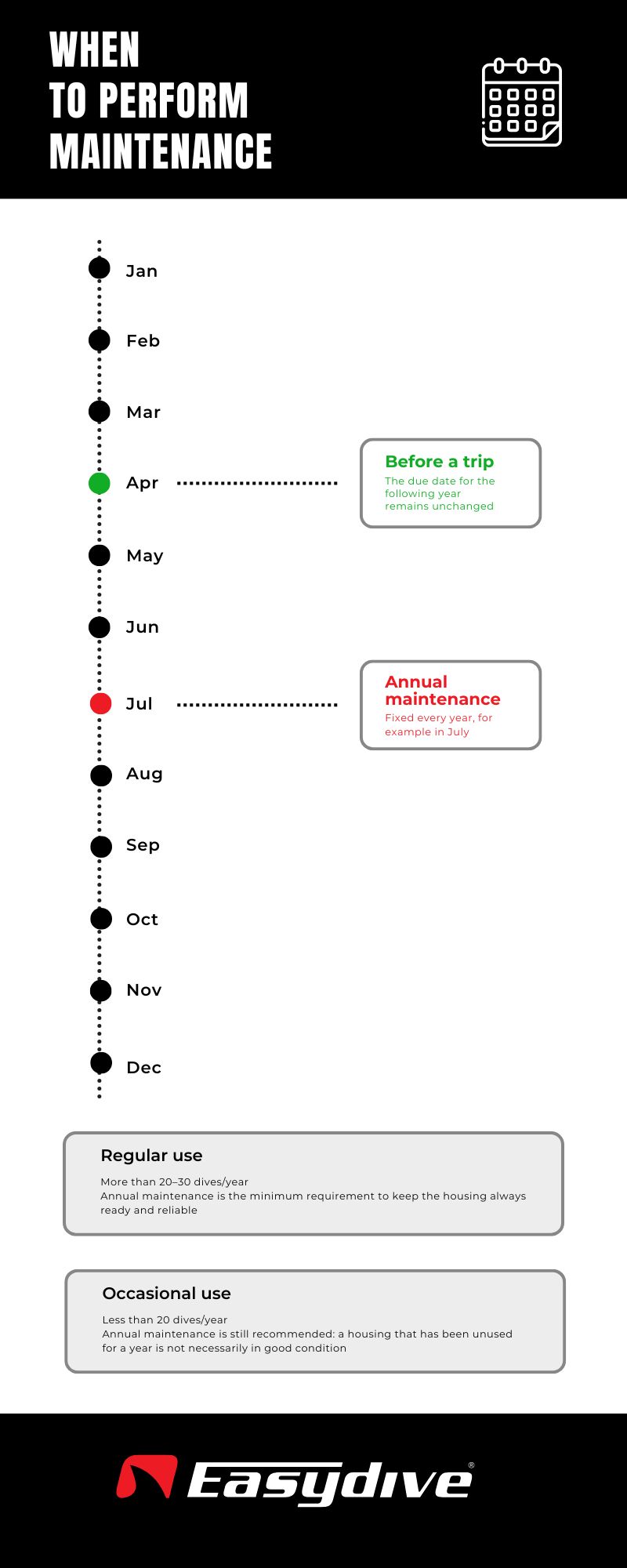
Regular use (more than 20-30 dives a year)
We recommend annual maintenance: it's the minimum to keep your housing always ready and reliable.
Occasional use (less than 20 dives a year)
Even if you use your housing infrequently, annual maintenance is still recommended. O-rings deteriorate even when not in use: rubber ages through oxidation, light and temperature. Magnetic buttons, even with specific protective treatments, can oxidise. Software needs regular updates to recognise your camera's new firmware. A housing left unused for a year isn't necessarily in good condition.
Before a trip or an important dive
If you're planning a wreck dive, a deep-water dive or a photo trip after a long period of inactivity: don't wait for the annual deadline. Bring your housing in for maintenance before you leave. If you bring it forward slightly, you don't lose coverage: the deadline stays the original one. The cost is the same. Peace of mind is priceless.
How does the Easydive maintenance service work?
The process is simple.
Step 1 — Fill out the request form
Request form: enter your housing model, the list of accessories included in the package and a brief description of its current condition. Let us know if you'd also like to purchase new items.
Step 2 — Arrange shipping
Easydive offers a worldwide Pickup & Delivery service. If you'd like to use it, contact us: we'll prepare a quote for you. Alternatively, you can send the housing directly to our lab in Cervia. Either way, let us know in advance and agree the shipment and timing with us.
Step 3 — Receive confirmation
As soon as the housing arrives at the lab, you'll receive a confirmation. If checks reveal damaged components not covered by warranty, you'll receive a quote before any additional work is carried out. No surprises on the invoice.
Step 4 — The housing comes back to you
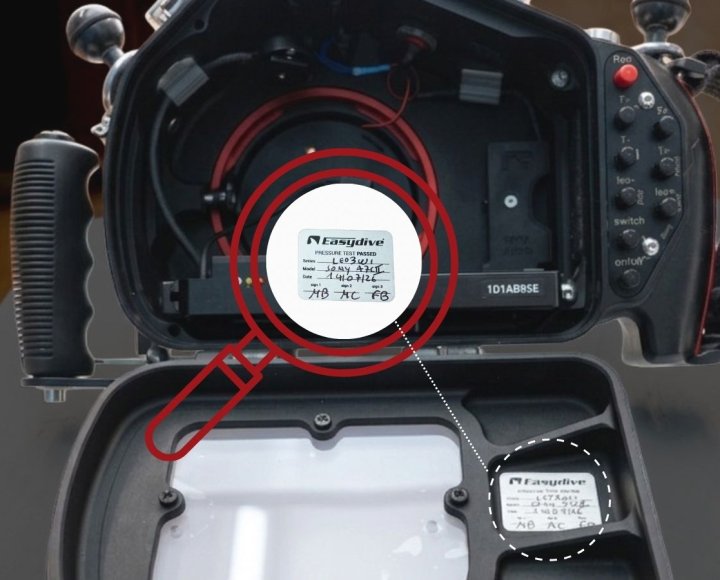
After the full cycle and testing, the housing is shipped back with an internal sticker showing the service date and certifying the warranty has been renewed. Average turnaround time is around 2 weeks.
What you can do, before and after every dive
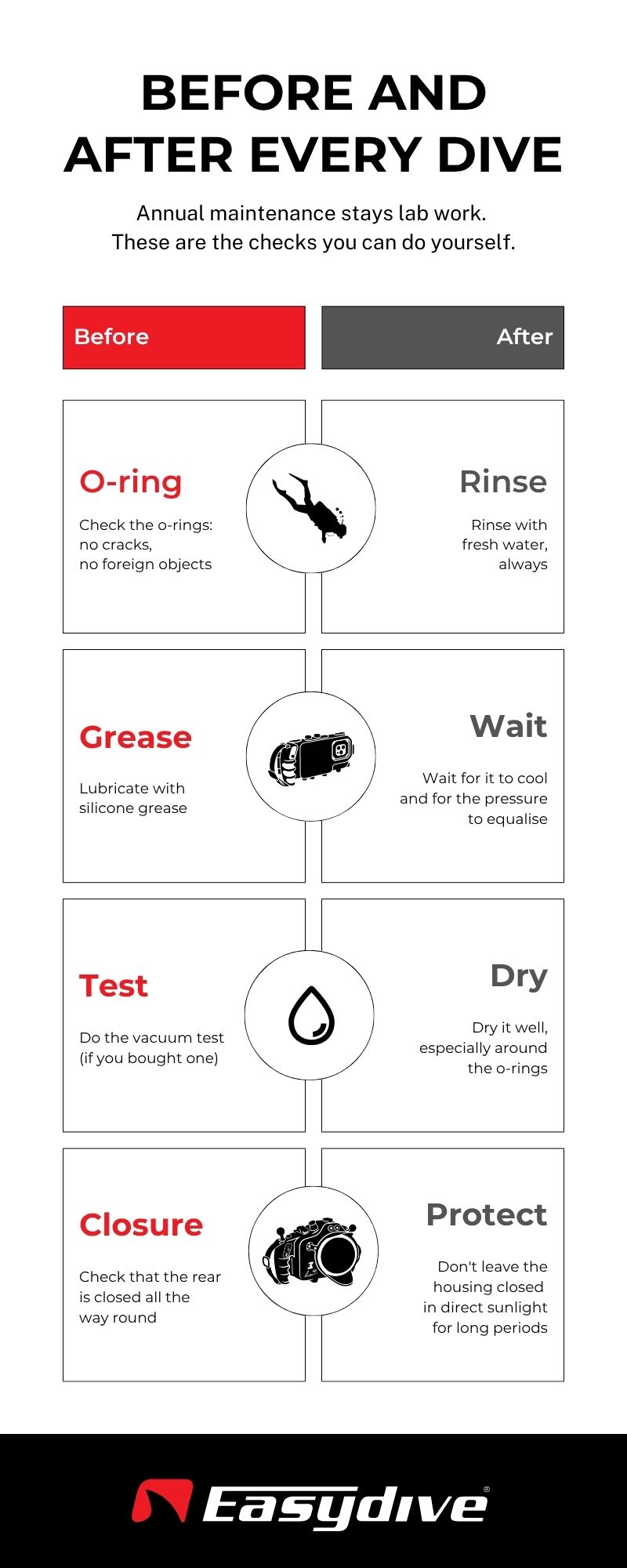
Annual maintenance is the lab's job. These are the checks you can do yourself.
Before the dive:
- Visually check the O-rings: no cracks, no foreign bodies (sand, hair, debris)
- Lubricate the O-rings with the recommended silicone grease, not too much, not too little
- Do the vacuum test: check that the vacuum holds for at least 30 seconds (if you've purchased one)
- Check that the rear is properly closed all the way around
After every dive:
- Rinse the housing with fresh water, always, even if you dived in fresh water
- Don't open the housing right away: wait for it to cool down and for the pressure to equalise
- Dry it thoroughly before storing, especially around the O-rings
- Don't leave the closed housing in direct sunlight for extended periods
FAQ
How often should an underwater housing be serviced?
We recommend every 12 months (Europe) or 18 months (outside the EU).
What happens if I skip maintenance?
The lifetime warranty remains active only with maintenance carried out within the indicated timeframes. Skipping a year doesn't automatically void the warranty, but it reduces coverage in the event of a failure linked to component wear.
Can I do the maintenance myself?
Lubricating the O-rings and pre-dive visual checks, yes. Replacing the O-rings, checking the internal wiring, updating the software and testing in the pressure chamber require specific tools and are carried out by the Easydive lab.
How long does it take?
Turnaround times depend on the time of year and the work required. You'll agree these directly with the Easydive team. As a general guide, the service takes around 2 weeks.
How much does maintenance cost?
Check the prices on this page.
Is maintenance mandatory to keep the warranty valid?
Yes. The Easydive lifetime warranty is conditional on periodic maintenance being carried out within the indicated timeframes.
Want to book maintenance for your housing? Fill out the form or contact the Easydive team at +39 338 9994219.
shop
 DSLR/MirrorlessDSLR/Mirrorless
 SmartphoneSmartphone
 TabletTablet
 360 Video Camera360 Video Camera
 Action CamAction Cam
 Flash SalesFlash Sales
 Underwater Led LampsUnderwater Led Lamps
 Underwater StrobesUnderwater Strobes
 Accessories for Underwater LampsAccessories for Underwater Lamps
 Accessories for Underwater StrobesAccessories for Underwater Strobes
 Flash SalesFlash Sales
 PortsPorts
 Accessories for Underwater HousingAccessories for Underwater Housing
 Arms and AccessoriesArms and Accessories
 Base for scooter DPVBase for scooter DPV
 Bagpacks and CasesBagpacks and Cases
 Flash SalesFlash Sales
- Configure your Housing
 Underwater Housing
 Underwater Lighting
 Accessories
 Plexiglass Ports
 Crystal Glass Ports
 Extensions
 Port Rings
 Covers and Taps
 Port Spare Parts
 Recommended Accessories
 Batteries and Cables
 Viewfinders
 Additional Lenses and Filters
 Remote Control
 Brackets and Straps
 Accessories Spare Parts
 External Monitors
 Clothing and Gadgets
 Arm Kits
 Arms
 Floats
 Clamps
 Balls and Mounts
 Trays
 Handles and Grips
 Polecams
 Tripods
 Arms and Mounts Spare Parts
 Helmets
Account
- Login
- Sign in
- Reset password
- Newsletter
- Photo credit
